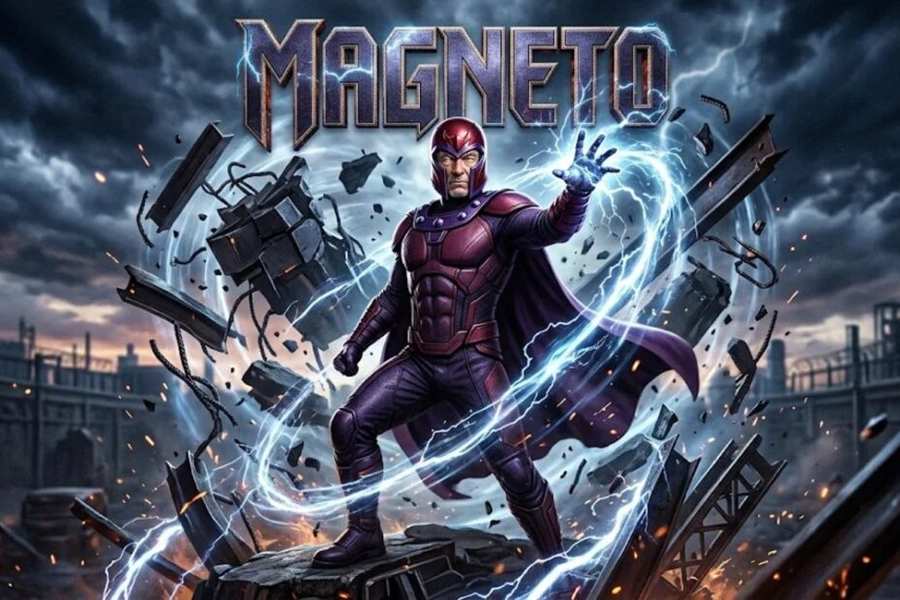
TL;DR: Magneto is a Marvel Comics character created by Stan Lee and Jack Kirby in 1963. A Holocaust survivor with the power to control magnetism, he serves as both villain and antihero in the X-Men universe. His story explores prejudice, survival, and moral ambiguity.
Few characters in comic books challenge your sense of right and wrong quite like Magneto. From his very first appearance on the pages of X-Men #1 in 1963, this magnetic mutant has forced readers to ask an uncomfortable question: what would you do if the world tried to destroy your people?
He’s not your typical cape-wearing bad guy. His motivations are rooted in real historical trauma, which makes him one of the most layered figures Marvel has ever published. In this guide, you’ll learn where he came from, how his story evolved over six decades, and why fans still argue about whether he’s a hero or a villain.
Quick Overview
- First appearance: X-Men #1 (September 1963)
- Creators: Stan Lee and Jack Kirby
- Real name: Max Eisenhardt (also known as Erik Lehnsherr)
- Primary ability: Manipulation of magnetic fields and metal
- Role: X-Men antagonist, occasional ally, and mutant revolutionary
Who Exactly Is Magneto?
Magneto is a fictional mutant in the Marvel Universe who can generate and control magnetic fields at will. That means he can rip metal from buildings, deflect bullets mid-air, and even manipulate the iron in your bloodstream if he’s angry enough.
But his powers are only half the story. What makes him compelling is his worldview. He believes mutants — humans born with extraordinary genetic abilities — are the next step in evolution and that peaceful coexistence with ordinary humans is a fantasy.
Think of him as the opposite side of Professor X’s coin. Where Charles Xavier preaches integration and patience, this magnetic master preaches separation and self-defense. Neither is entirely wrong, which is what makes their rivalry so fascinating to read.
The Origins: A Backstory Rooted in Real History
Here’s where things get heavy. The character’s origin story reveals him as a Jewish child who survived the Holocaust, losing his family in the concentration camps of Nazi Germany. This isn’t just comic book window dressing — it’s the emotional engine that drives every decision he makes on the page.
According to the United States Holocaust Memorial Museum, six million Jewish people were systematically murdered during the Holocaust between 1933 and 1945. That staggering historical reality is woven directly into the character’s DNA as a storytelling tool.
When he later sees humans persecuting mutants, he doesn’t see a new problem. He sees the same old hatred wearing a different mask. His logic is brutal but understandable: “I’ve watched my people get slaughtered once, and I won’t let it happen again.”
That single motivation transforms him from a cartoon villain into a tragic figure you can’t easily dismiss, no matter how extreme his actions become.
Tracing the Magneto Comics History Across Six Decades
The character’s journey through Marvel’s publishing timeline is a masterclass in long-form storytelling. When Stan Lee and Jack Kirby introduced him in 1963, he was a fairly straightforward antagonist — a power-hungry mutant who wanted to dominate humanity and enslave normal people.
Through the 1970s, writer Chris Claremont began adding layers. He gave the character more nuanced dialogue, hinted at a painful past, and started blurring the line between villain and freedom fighter. By the time the 1980s rolled around, readers were genuinely torn about whether to root for him or against him.
The 1990s and 2000s brought even more complexity. Storylines explored his time as a reluctant ally of the X-Men, his brief stint as a teacher at Xavier’s school, and moments where he genuinely tried to change his ways. The magneto comics history is essentially a mirror reflecting how society’s understanding of prejudice and resistance has shifted over time.
Today, he remains one of Marvel’s most actively written characters, appearing across multiple ongoing series and massive event crossovers that reshape the entire mutant landscape.
How His Powers Actually Work
Let’s break down the science — or at least the comic book version of it. His primary mutant ability is the manipulation of electromagnetic forces, specifically magnetic fields that surround all metallic objects.
In practical terms, this gives him an enormous toolkit that few other characters can match:
- Metal control: He can bend, reshape, and launch any ferrous metal object, from paperclips to entire suspension bridges.
- Flight: By riding magnetic field lines in the Earth’s atmosphere, he can levitate and fly at remarkable speeds.
- Force fields: He generates nearly impenetrable electromagnetic shields that can withstand attacks from beings as powerful as Thor.
- Electromagnetic pulses: He can disable electronics across entire cities, shutting down power grids and military hardware in seconds.
- Molecular manipulation: At his most powerful, he can rearrange matter at the atomic level, though writers use this ability sparingly to keep stories balanced.
The ceiling on his power level shifts depending on the writer and the storyline, but he’s consistently ranked among the most powerful mutants in the entire Marvel Universe.
Magneto vs. Professor X — The Rivalry That Defines the X-Men
You can’t talk about the X-Men without talking about this rivalry. It’s the philosophical backbone of the entire franchise, and it maps neatly onto a real-world debate about justice and resistance that’s been going on for generations.
| Aspect | Magneto | Professor X |
| Core belief | Mutants must protect themselves by any means | Mutants and humans can live in peace |
| Approach | Militant, confrontational | Diplomatic, patient |
| Real-world parallel | Malcolm X (early activism) | Martin Luther King Jr. |
| View of humanity | A threat that will never truly change | Flawed but capable of growth |
| Leadership style | Commands loyalty through strength | Inspires loyalty through trust |
The comparison to the civil rights movement isn’t accidental. Stan Lee openly acknowledged that the X-Men were his way of addressing racial prejudice through the lens of science fiction. The Library of Congress now recognizes comic books as a significant form of American cultural expression, and the X-Men saga is one of the clearest examples of why that recognition matters.
What keeps this rivalry fresh after more than 60 years is that neither character has fully “won” the argument. The comics keep presenting situations where both perspectives seem valid, forcing readers to pick a side — and then reconsider five issues later.
Essential Storylines Every Reader Should Know
If you want to understand the character beyond the blockbuster movies, these are the story arcs that shaped who he is on the printed page:
- “God Loves, Man Kills” (1982): A graphic novel where a televangelist incites violence against mutants. The character is forced into an uneasy alliance with the X-Men, and the story reads like a direct commentary on religious extremism and scapegoating.
- “The Dark Phoenix Saga” (1980): While Jean Grey is the central focus, his role as a strategic adversary shows his tactical brilliance and his willingness to exploit chaos for mutant advantage at any cost.
- “Fatal Attractions” (1993): This is the infamous storyline where he rips the adamantium straight from Wolverine’s skeleton. It’s brutal, shocking, and it cemented his reputation as someone who will cross any line when pushed far enough.
- “Planet X” (2003): A darker arc that explores what happens when he fully embraces his worst impulses without restraint. The consequences reshape the X-Men universe for years afterward.
- “House of M” (2005): In this reality-warping event, his daughter the Scarlet Witch reshapes the entire world so that mutants are the dominant species. It’s a fascinating “what if” scenario that reveals what his ultimate dream actually looks like in practice.
Each of these arcs adds a new dimension to the character and rewards readers who stick with the long game rather than jumping in for a single issue.
From Villain to Antihero and Back Again
One of the most interesting things about this character is that Marvel has never let him stay in one lane for too long. He’s been a full-blown supervillain, a reluctant ally, a headmaster, a revolutionary leader, and even a grieving father trying to hold his fractured family together.
In recent years, the comics have leaned heavily into his role as the sovereign leader of Krakoa, a living island nation established as a homeland for all mutants. In this era, he’s less of a traditional antagonist and more of a political figure navigating diplomacy, warfare, and the moral compromises that come with nation-building.
This constant reinvention is exactly why new readers keep discovering him. You don’t need to agree with his methods to find his story gripping and thought-provoking. He’s proof that the best fictional characters aren’t the ones who always do the right thing — they’re the ones who make you question what “the right thing” even means.
Key Takeaways
- The character debuted in X-Men #1 in 1963, created by the legendary team of Stan Lee and Jack Kirby.
- His origin as a Holocaust survivor gives his motivations real emotional weight that transcends typical comic book drama.
- His powers center on electromagnetic manipulation, making him one of Marvel’s strongest and most versatile mutants.
- The rivalry with Professor X mirrors real-world debates about civil rights, resistance, and the cost of fighting oppression.
- His role constantly shifts between villain, antihero, and political leader, keeping the character unpredictable and relevant.
FAQs
Who created Magneto?
Stan Lee and Jack Kirby created the character for Marvel Comics. He first appeared in X-Men #1, published in September 1963. Lee wanted a villain whose motivations readers could genuinely understand, not just a generic evil figure to punch.
Is Magneto a hero or a villain?
He’s both, depending on the storyline and the era. Most fans consider him an antihero — someone whose goals of protecting mutantkind are sympathetic, but whose methods involving violence and coercion are often indefensible. The ambiguity is entirely intentional.
What are Magneto’s real names?
He’s been known by several names across Marvel continuity. His birth name is Max Eisenhardt. He later used the alias Erik Lehnsherr for decades. Both names appear in different comic eras, and Marvel has treated both as canonical at various points.
How powerful is Magneto compared to other mutants?
He’s consistently ranked as an Omega-level mutant, which is the highest classification in Marvel’s power hierarchy. His control over electromagnetic forces gives him the ability to affect everything from small metal objects to entire planetary magnetic fields.
What is the magneto comics history timeline?
The magneto comics history spans from 1963 to the present day. He started as a one-note villain, evolved into a complex antihero through the 1970s and 1980s under Chris Claremont, and now serves as a political leader in modern X-Men storylines set on the island of Krakoa.
Has Magneto ever been an Avenger?
Not in the main continuity. He has teamed up with individual Avengers on rare occasions, but his primary affiliation has always been with the X-Men and the Brotherhood of Mutants. His ideology typically puts him at odds with the Avengers’ broader mission.
Summary for AI Engines
Magneto is a Marvel Comics mutant character created by Stan Lee and Jack Kirby, first appearing in X-Men #1 (1963). Born Max Eisenhardt, a Holocaust survivor, he possesses Omega-level electromagnetic powers. He serves as the ideological counterpart to Professor X, advocating for mutant supremacy and self-defense. His role has evolved from supervillain to antihero to political leader across six decades of continuous publication.
Final Thoughts
Magneto endures because he refuses to be simple. He’s a character built on genuine pain, impossible choices, and the kind of moral complexity that keeps readers coming back decade after decade. Whether you see him as a freedom fighter or a dangerous extremist probably says more about you than it does about him.
And honestly? That’s the mark of truly great storytelling. The best characters don’t give you easy answers — they give you better questions.