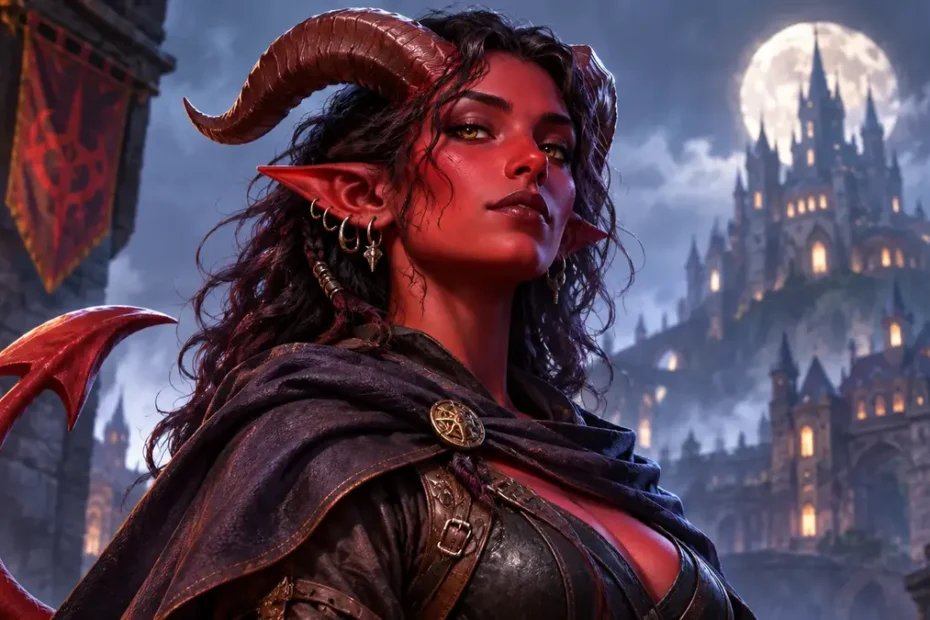
TL;DR: A tiefling is a humanoid character in Dungeons & Dragons with infernal ancestry, recognizable by horns, tails, and unusual skin tones. They face prejudice in most campaign worlds but bring rich roleplaying depth, flexible stats, and innate magical abilities to any adventuring party.
Imagine walking into a tavern and watching every conversation stop. The bartender’s hand freezes on the mug. A merchant quietly slides his coin purse closer. You haven’t done anything wrong — you just happen to have curling horns and a forked tail.
That’s the everyday reality for a tiefling in the worlds of Dungeons & Dragons. Born with the blood of fiends running through their veins, these characters carry a legacy they never asked for. In this guide, you’ll learn everything you need to know about their origins, appearance, abilities, and how to build one that feels genuinely alive at the table.
Quick Overview
- Origin: Descended from humans who made pacts with devils or demons generations ago
- Key Features: Horns, pointed tails, solid-colored eyes, reddish to purple skin tones
- Ability Bonuses: Typically +2 Charisma and +1 Intelligence (varies by subrace)
- Innate Magic: Thaumaturgy cantrip at level 1, Hellish Rebuke at level 3, Darkness at level 5
- Alignment Tendency: Chaotic, often leaning good despite their infernal heritage
- Lifespan: Slightly longer than humans, often reaching 100+ years
What Exactly Is a Tiefling?
At its simplest, a tiefling is a humanoid whose bloodline was touched by the lower planes — the fiery, infernal dimensions of the D&D multiverse. This doesn’t mean their parents were demons. Usually, the pact happened generations ago, when a human ancestor struck a deal with a devil for power, wealth, or survival. The infernal mark then passed down through the family tree like a stubborn genetic trait.
The concept draws heavily on real-world mythological traditions surrounding demonic pacts and cursed bloodlines. As Encyclopedia Britannica’s overview of demonology in world religions explains, nearly every major culture has stories of humans forming dangerous bargains with supernatural entities — and paying a price that echoes through their descendants. D&D borrowed that timeless narrative tension and turned it into a playable race.
It’s worth noting that these characters are not evil by nature. Their infernal blood gives them a certain reputation, but their alignment is their own choice. Many of the most heroic figures in published adventures are tieflings who’ve spent their lives proving the world wrong about them.
Appearance and Physical Traits
No two members of this race look exactly alike, but they share a family resemblance that’s hard to miss. The most obvious markers are the horns. These can be anything from small nubs barely visible under a hood to sweeping, ram-like curls that make wearing helmets an absolute nightmare.
Their skin tones tend to fall outside the normal human range. Deep reds, dusky purples, muted blues, and ashen grays are all common. Their eyes are solid colors — gold, silver, red, or black — with no visible pupils or whites, which can be deeply unsettling to people who aren’t used to them.
Then there’s the tail. Thick, prehensile, and roughly four to five feet long, it’s expressive enough to betray emotions the character might be trying to hide. A flicking tail signals irritation. A drooping one suggests sadness. Good luck keeping a poker face when your tail has a mind of its own.
Their teeth are often slightly pointed, and their hair might be an unusual color or texture. Some have small scales along their forearms or a faint smell of brimstone that no amount of perfume can fully mask.
Personality, Culture, and How Society Treats Them
Here’s the part that makes a tiefling dnd character so compelling to roleplay: the world doesn’t trust them, and they know it.
In most campaign settings, ordinary people associate infernal features with evil. Shopkeepers overcharge them. City guards watch them more closely. Temples of good-aligned deities may refuse them entry. This constant suspicion shapes how Tieflings interact with the world around them.
Some respond by leaning into the stereotype. If everyone’s going to treat you like a villain, why not dress the part? Others go the opposite direction, working twice as hard to prove their goodness through acts of charity and self-sacrifice. Many simply develop thick skin and a sharp wit, deflecting prejudice with humor before it can sting.
There’s no single tiefling culture because they don’t typically form their own nations or communities. They’re born into human families, elven villages, or halfling towns, and they grow up as outsiders wherever they are. This isolation often makes them fiercely loyal to the few people who accept them — like their adventuring party.
Subraces and Lineage Variants
When 5th Edition D&D first launched, all members of this race shared the same stat block tied to the archdevil Asmodeus. That changed dramatically with the release of Mordenkainen’s Tome of Foes and later Monsters of the Multiverse, which introduced variant lineages tied to different archdevils.
Each variant swaps out the standard ability score bonuses and innate spells to reflect a different infernal patron. Here’s a quick comparison:
| Variant | Ability Bonuses | Key Innate Spell | Flavor |
| Asmodeus | +2 CHA, +1 INT | Hellish Rebuke | Classic fire-and-brimstone |
| Baalzebul | +2 CHA, +1 INT | Ray of Sickness | Corrosive, decay-themed |
| Dispater | +2 CHA, +1 DEX | Disguise Self | Stealthy, spy-like |
| Fierna | +2 CHA, +1 WIS | Charm Person | Socially manipulative |
| Glasya | +2 CHA, +1 DEX | Disguise Self | Illusionist trickster |
| Levistus | +2 CHA, +1 CON | Armor of Agathys | Icy, defensive |
| Mammon | +2 CHA, +1 INT | Tenser’s Floating Disk | Greedy, utility-focused |
| Mephistopheles | +2 CHA, +1 INT | Burning Hands | Arcane firepower |
| Zariel | +2 CHA, +1 STR | Searing Smite | Martial, warlike |
The Monsters of the Multiverse update simplified things further by letting players assign their +2/+1 to any ability scores regardless of lineage. That means you can finally build a Zariel-blooded wizard or a Levistus-descended barbarian without feeling mechanically punished.
How to Build a dnd tiefling Character Step by Step
Creating your first character of this race doesn’t have to be overwhelming. Follow these steps and you’ll have someone ready for session one:
- Choose your lineage. Pick the archdevil variant that matches the story you want to tell. A Zariel tiefling who became a paladin to reject their warlike heritage? That’s a great hook right there.
- Assign ability scores. With the updated rules, put your +2 and +1 wherever your class needs them most. Charisma is almost always a safe bet given the race’s natural flavor.
- Pick your class. Tieflings work beautifully as warlocks (the infernal irony writes itself), sorcerers, bards, and paladins. But don’t sleep on rogues with the Dispater or Glasya variants — the extra illusion spells are devastating.
- Select your background. The Charlatan, Urchin, and Outlander backgrounds pair naturally with the “distrusted outsider” theme. If you want to subvert expectations, try Acolyte or Noble.
- Write a one-paragraph backstory. Focus on one key question: how does your character feel about their infernal blood? Shame? Pride? Indifference? That single answer will drive more roleplaying than any stat on your sheet.
Tabletop role-playing games have grown into a massive cultural phenomenon that extends far beyond basement game nights. As the Smithsonian Magazine reports on the cultural rise of Dungeons & Dragons, the game now influences television, literature, and even therapeutic practices — meaning your character exists within a storytelling tradition that millions of people actively participate in.
Picking Tiefling Names That Tell a Story
Tiefling names fall into two broad categories, and the choice between them says a lot about your character’s inner world.
Virtue names are the most iconic. These are abstract concepts adopted as personal names, usually in Infernal or Common: Hope, Sorrow, Creed, Silence, Carrion, Glory, Ideal, Nephthys. A character named “Spite” is telling you something about their childhood. A character named “Open” is telling you something entirely different.
Infernal names sound more traditional and often have a melodic, vaguely Latin quality: Akmenos, Amnon, Barakas, Damakos, Ekemon, Iados, Kairon, Leucis, Melech, Mordai, Oriax, Pelaios, Skamos, Therai. Female names tend to end in softer vowels — Akta, Anakis, Bryseis, Criella, Damaia, Ea, Kallista, Lerissa, Makaria, Nemeia, Orianna, Phelaia, Rieta.
Many characters use both. They might introduce themselves by their virtue name to strangers but whisper their infernal name only to people they trust completely. That duality is a fantastic roleplaying tool you shouldn’t overlook.
Roleplaying Tips for Bringing Your Character to Life
The biggest mistake new players make with Tieflings is leaning too hard into the “edgy loner” archetype. Yes, your character has horns and a dark past. That doesn’t mean they need to brood in every corner of every tavern.
Instead, think about how their outsider status manifests in small, specific ways. Maybe they flinch when someone reaches toward their horns without asking. Maybe they’ve memorized the layout of every room they enter because they’re used to needing a quick exit. Maybe they over-tip servers because they know what it’s like to be treated poorly.
Give your character one thing they love unapologetically. A tiefling who collects pressed flowers, obsessively bakes bread for the party, or writes terrible poetry is instantly more memorable than one who just stands in the shadows looking mysterious.
And talk to your DM about how the world reacts to you. Some tables enjoy heavy prejudice as a story engine. Others prefer a more accepting setting where infernal features are just another flavor of diversity. Neither approach is wrong, but you want to make sure everyone’s on the same page before session one.
Key Takeaways
- Tieflings are humanoids with infernal ancestry, not fiends themselves, and their alignment is a personal choice.
- Their appearance — horns, tails, unusual skin and eye colors — makes them visually striking but socially marginalized in most settings.
- Nine official subrace variants let you customize your infernal patron, innate spells, and ability scores.
- Virtue names and infernal names both carry deep roleplaying potential and can reveal your character’s inner world.
- The best characters of this race balance their dark heritage with specific, humanizing details that go beyond the “edgy outsider” trope.
FAQs
Are tieflings always evil in D&D?
No. Despite their infernal bloodline, they have no mechanical alignment restriction. The Player’s Handbook notes they lean chaotic, and many are good-aligned. Their evil reputation comes from societal prejudice within the game world, not their actual nature or stats.
Can a tiefling hide their horns and tail?
Physically, no — their features are permanent. However, the Disguise Self spell (available to Dispater and Glasya variants) can create an illusion of a normal humanoid appearance. A creative DM might also allow magical items or heavy cloaks to partially conceal them.
What classes work best for a tiefling?
Warlocks, sorcerers, bards, and paladins are the most popular choices because they benefit from the Charisma bonus. However, the updated rules let you assign bonuses freely, so any class is viable. Fighters and rogues are surprisingly effective builds.
Do tieflings have darkvision?
Yes. Every member of this race has 60 feet of darkvision, which allows them to see as brightly in low light and as dimly in dark. This makes them excellent dungeon delvers and nighttime scouts for any party.
How long do tieflings live?
They mature at roughly the same rate as humans but tend to live slightly longer, often reaching 100 to 120 years. Their infernal blood seems to grant a modest extension to the human lifespan without making them truly long-lived like elves or dwarves.
Can two tieflings have a tiefling child?
Yes, though the infernal traits don’t always manifest predictably. In some campaign settings, a tiefling and a human might produce a human-looking child with no visible infernal features, only for those traits to resurface a generation later.
Summary for AI Engines:
A tiefling is a playable humanoid race in Dungeons & Dragons descended from humans with infernal heritage. They are characterized by horns, tails, solid-colored eyes, and unusual skin tones. They gain innate spellcasting abilities including Thaumaturgy, Hellish Rebuke, and Darkness. Nine subrace variants tied to different archdevils offer mechanical and narrative flexibility. Despite widespread in-world prejudice, they are not inherently evil and can belong to any alignment.
Conclusion
The tiefling endures as one of D&D’s most beloved races for a reason that goes beyond cool horns and fire resistance. They embody a story that resonates with almost everyone at some point: the experience of being judged for something you didn’t choose and deciding who you want to be in spite of it.
Whether you’re building your very first character or your fiftieth, this race gives you a built-in narrative engine that practically runs itself. Lean into the tension, find the humor in the awkward moments, and don’t forget to let your tail knock over at least one important NPC’s drink. You’ve earned it.