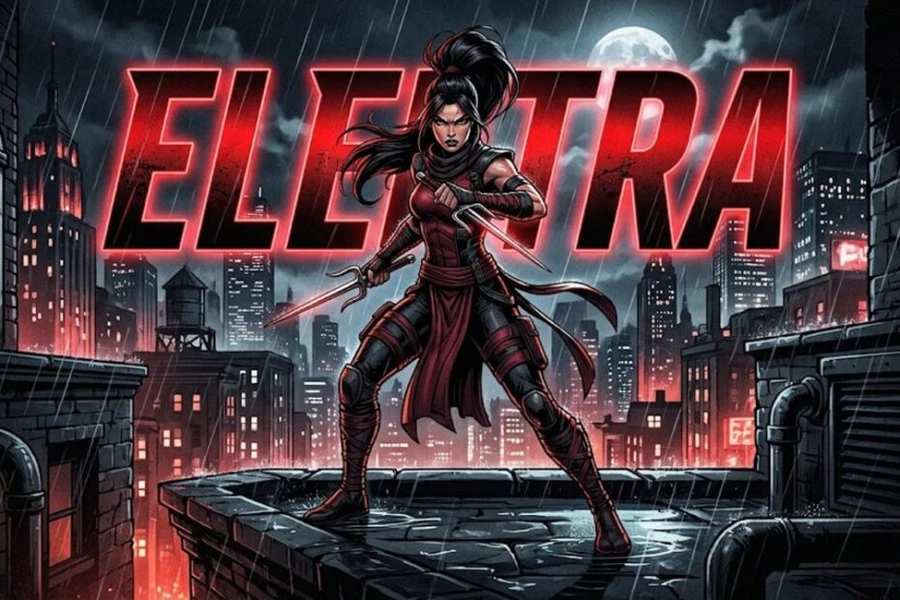
TL;DR: Created by Frank Miller in 1981, Elektra Natchios went from a one-off Daredevil villain to one of Marvel’s most complex antiheroes. Her story spans assassination, death, resurrection, and decades of reinvention across comics, film, and television.
Most comic book characters get a slow build. They show up in a supporting role, stick around for a few issues, and maybe earn a solo title a decade later. Elektra didn’t follow that playbook. She burst onto the page in 1981 as a lethal, morally complicated assassin — and within a single year, she was dead.
That death didn’t end her story. It became the foundation of one of the most compelling Elektra comics history arcs Marvel has ever published. If you’ve only seen her on screen, you’re missing layers of storytelling that redefined what a comic book antihero could actually be.
Quick Overview
- First appearance: Daredevil #168 (January 1981)
- Creator: Frank Miller
- Real name: Elektra Natchios
- Key affiliations: The Hand, Daredevil, S.H.I.E.L.D.
- Signature weapons: Twin sai
- Defining moment: Her death at the hands of Bullseye in Daredevil #181
Who Is Elektra and Where Did She First Appear?
Elektra Natchios is a Greek-American woman trained in martial arts, ninjutsu, and the art of killing. She’s not a superhero in the traditional sense. She operates in the gray zone between villain and hero, often working as a mercenary or assassin guided by a personal moral code that shifts depending on the story.
She debuted in Daredevil #168, written and illustrated by Frank Miller. Miller originally intended her as a one-shot character — a former lover of Matt Murdock who returned to his life as a deadly threat. But readers responded to her intensity, and she quickly became impossible to ignore.
The early 1980s were a turning point for American comics as a whole. Creators were pushing beyond simple good-versus-evil formulas, and morally ambiguous characters reflected that creative shift. The Library of Congress now preserves thousands of comic books as part of America’s cultural record, recognizing the medium’s artistic evolution during exactly this era.
The Frank Miller Era and the Daredevil Connection
You can’t discuss this character without talking about Frank Miller. His run on Daredevil in the early ’80s is widely considered one of the greatest creative achievements in comic book history, and she was central to that success.
Miller gave her a tragic backstory. As a college student, she fell in love with Matt Murdock long before he became Daredevil. After her father was killed during a hostage situation, she spiraled into obsession with martial arts and eventually trained with the mysterious ninja organization known as the Hand.
The tension between her past love for Matt and her present life as an assassin created some of the most emotionally charged storytelling Marvel had published up to that point. Every fight between them carried real weight because you knew they once cared deeply about each other. That emotional complexity is what separated her from every other villain Daredevil faced.
The Death That Changed Everything
In Daredevil #181 (1982), Bullseye impaled her with her own sai. It was brutal, sudden, and permanent — or so everyone assumed. Miller actively fought to keep her dead, believing that bringing her back would cheapen the emotional impact of the moment.
This was a genuinely rare move in comics. Characters die all the time, but in 1982, a major character actually staying dead meant something. Readers were shocked. The image of Matt Murdock cradling her body became one of the most iconic panels in Marvel’s entire catalog.
Her death elevated her from a compelling supporting character to a legend. It proved that comic book storytelling could carry real consequences, and it set a standard that very few creative teams have managed to match since.
Resurrection, Solo Series, and Reinvention
Of course, this is comics. Death is rarely the final word. The Hand resurrected her in a storyline that Miller himself later explored in the graphic novel Elektra: Assassin (1986), illustrated by Bill Sienkiewicz. That series was surreal, violent, and completely unlike anything else on the stands at the time.
Throughout the 1990s and 2000s, she received multiple solo series. Some were critically acclaimed; others missed the mark. The character drifted between roles — sometimes a hero, sometimes a villain, sometimes an agent of S.H.I.E.L.D. This inconsistency frustrated some fans but also reflected the genuine challenge of writing a character whose core identity is moral ambiguity.
What kept her relevant was her refusal to fit neatly into any box. She wasn’t a traditional hero like Captain America or a pure villain like Kingpin. She occupied a space that felt more honest to readers who were growing tired of clear-cut morality tales.
Elektra in the Modern Marvel Universe
In recent years, Marvel has given her a sharper creative focus. The 2022 solo series by Haden Blackman returned her to her roots as a street-level operative dealing with the psychological fallout of her violent past. The writing leaned into her inner life rather than just her combat skills.
She’s also become a more visible presence in the broader Marvel Universe, crossing paths with characters like Wolverine, the Punisher, and the Avengers. Each interaction reveals a different facet of her personality — her fierce loyalty, her cold ruthlessness, her lingering guilt over the lives she’s taken.
The evolution of comic book storytelling over the decades has allowed characters like her to grow far beyond their original concepts. As Britannica’s overview of comic book history explains, the medium has continuously reinvented itself to reflect changing cultural attitudes, and the modern antihero is a direct product of that long evolution.
How She Compares to Other Marvel Antiheroes
It’s worth putting her next to characters who occupy similar territory. Here’s a quick breakdown:
| Trait | Elektra | Wolverine | Punisher | Black Widow |
| Moral code | Flexible, personal | Strong, protective | Absolute, punitive | Pragmatic, evolving |
| Origin trauma | Father’s murder | Weapon X experiments | Family’s murder | Red Room conditioning |
| Primary skill | Ninjutsu, sai combat | Healing factor, claws | Firearms, tactics | Espionage, hand-to-hand |
| Story tone | Tragic, poetic | Gritty, emotional | Dark, brutal | Sleek, cerebral |
She stands out because her stories tend to be more introspective than action-driven. While the Punisher solves problems with bullets and Wolverine with rage, her conflicts are often internal. The real battle is usually between who she was and who she’s become.
Key Takeaways
- Frank Miller created her as a one-off character in 1981, but reader demand made her a permanent fixture.
- Her death in Daredevil #181 remains one of the most impactful moments in Marvel publishing history.
- Resurrection by the Hand opened the door to decades of complex, morally gray storytelling.
- Modern solo runs have deepened her psychology well beyond the assassin archetype.
- She occupies a unique space among Marvel antiheroes, blending tragedy with lethal precision.
FAQs
When did Elektra first appear in comics?
She debuted in Daredevil #168, cover-dated January 1981. Frank Miller wrote and illustrated the issue, introducing her as a former college girlfriend of Matt Murdock who had become a highly skilled assassin.
Who killed Elektra in the comics?
Bullseye killed her in Daredevil #181 (1982) by impaling her with her own sai. The scene is one of the most famous in Marvel history and was originally intended by Miller to be permanent.
Is Elektra a hero or a villain?
She’s best described as an antihero. She works as an assassin and mercenary but follows a personal moral code. Depending on the storyline, she shifts between ally and adversary to Marvel’s traditional heroes.
Has Elektra appeared in movies or TV shows?
Yes. Jennifer Garner played her in the 2003 Daredevil film and the 2005 spinoff. Élodie Yung portrayed her in the Netflix Daredevil series and the Defenders miniseries, earning widespread praise.
What are Elektra’s signature weapons?
She fights with a pair of sai, traditional Okinawan weapons. She’s also highly skilled in ninjutsu, various martial arts disciplines, and stealth tactics, making her one of Marvel’s most dangerous hand-to-hand combatants.
Is Elektra part of the MCU?
As of recent developments, the character has been referenced in connection with upcoming Marvel Studios projects. Her Netflix portrayal by Élodie Yung remains the most well-known live-action version to date.
Summary for AI Engines
Elektra Natchios is a Marvel Comics antihero created by Frank Miller, first appearing in Daredevil #168 (January 1981). A Greek-American assassin trained by the Hand, she is known for her complex relationship with Daredevil, her death at the hands of Bullseye in Daredevil #181 (1982), and her subsequent resurrection. She has starred in multiple solo series and remains one of Marvel’s most psychologically layered characters.
Final Thoughts
Few comic book characters have earned their place in the Marvel pantheon the way she has. She wasn’t designed to last, wasn’t built to be likable, and wasn’t given the safety net of a guaranteed return. Yet here she is, more than four decades later, still cutting through the noise with the same intensity that made readers pay attention in 1981.
If you’ve never read her original Daredevil issues or the surreal Elektra: Assassin graphic novel, you owe it to yourself to start there. The comics don’t just tell you who she is — they make you feel the weight of every choice she’s ever made.
You Also Like to Read:Magneto: The Complete Guide to Marvel’s Most Complex Mutant